
The Patna High Court has set aside a man’s conviction for attempt to rape in a 2010 case from Begusarai, Bihar, and convicted him instead for outraging a woman’s modesty under Section 354 of the Indian Penal Code (IPC).
Justice Sandeep Kumar held that switching off the light, lying on the woman and pressing her mouth did not, on the evidence before the court, show any act towards penetration. The act therefore did not go beyond the stage of preparation, the court said.
What the trial court had decided
The incident took place in February 2010. In July 2013, an Additional Sessions Judge in Begusarai convicted the accused under Sections 376/511 IPC (attempt to rape) and Section 448 IPC (house trespass). He was sentenced to four years of rigorous imprisonment for attempt to rape and six months for house trespass, to run together.
 Also readSupreme Court Seeks EC Reply on INDIA Bloc’s SIR Plea, Questions Rahul Gandhi’s March: What Happened
What the High Court held
- The evidence did not establish that the accused went beyond preparation.
- Without an act towards penetration, the offence could not be treated as attempt to rape.
- The conviction under Sections 376/511 IPC was set aside.
- Using its power under Section 222(2) of the CrPC, the court convicted him under Section 354 IPC, as the section stood before the 2013 amendment.
- The sentence was reduced to the period he had already undergone.
Why the ruling matters
The judgment turns on the legal line between preparation and attempt. Under criminal law, an attempt requires a direct act towards committing the offence. Courts have often been asked to decide where that line falls in sexual offence cases, and rulings on it regularly draw public debate.
Frequently asked questions
What did the Patna High Court rule?
The court held that the evidence did not show the accused went beyond the stage of preparation, as there was no act towards penetration. It set aside the conviction for attempt to rape and convicted him for outraging modesty under Section 354 IPC.
What was the original sentence?
In 2013, a Begusarai sessions court convicted him under Sections 376/511 IPC and sentenced him to four years of rigorous imprisonment, along with six months under Section 448 IPC for house trespass.
What is the new sentence?
The High Court reduced the sentence to the period he has already undergone.
Which judge delivered the ruling?
Justice Sandeep Kumar of the Patna High Court.
What is the difference between preparation and attempt?
In criminal law, preparation means arranging the means to commit an offence, while an attempt is a direct act towards committing it after preparation is complete. Courts look at whether the accused’s acts moved past preparation.
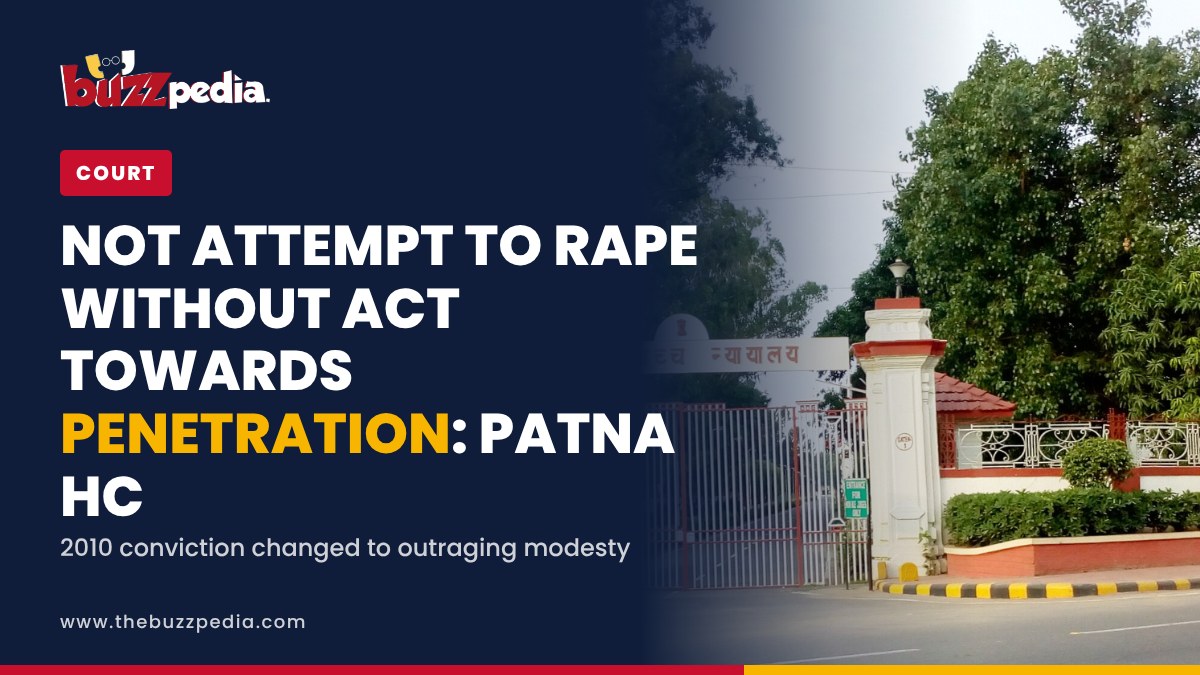
Sources: LiveLaw, Bar & Bench, The Indian Express. Photo: Shivamsetu / Wikimedia Commons, CC BY-SA 4.0 (Patna High Court gate, file photo).