


The most iconic Sony Ericsson phones that challenged Nokia in the 2000s were the T68i, the P series (P800 onwards), the Walkman W series led by the W800, the Cyber-shot K series including the K750 and K800i, and the T610. Each one led on a feature, from colour screens and MMS to music and cameras.
In the early 2000s, Nokia ruled the phone market, including in India. Sony Ericsson, a joint venture between Sony and Ericsson set up in 2001, did not try to beat Nokia on numbers. It went after people who cared about design, music and cameras, and for a few years it worked. At its peak in 2007, Sony Ericsson held about 9% of the global market and was the fourth-largest phone maker.
Quick facts: Sony Ericsson at a glance
| Detail | Information |
|---|---|
| Formed | 2001, joint venture of Sony and Ericsson |
| Headquarters | London, with a design centre in Lund, Sweden |
| Peak | About 9% global share in 2007, fourth largest |
| Famous sub-brands | Walkman (2005), Cyber-shot (2006) |
| Sony buyout | Completed 16 February 2012, for 1.05 billion euros |
| Became | Sony Mobile Communications, later folded into Sony |
5 iconic Sony Ericsson phones that challenged Nokia
1. Sony Ericsson T68i (2002)
The T68 began life as an Ericsson phone in late 2001. It was the first Ericsson handset with a colour screen, a 101 by 80 pixel display with 256 colours, and it had Bluetooth for sharing ringtones and wallpapers.
 Also readTop 10 Most Subscribed YouTube Channels in the World (2026)
In 2002 it was relaunched as the Sony Ericsson T68i. The upgrade added two-way MMS, which the company promoted as a first. There was no built-in camera. Instead, buyers could attach the CommuniCam, a small add-on camera, which let users take photos and send them by MMS.
2. Sony Ericsson P series (2002 onwards)
The P800, released in September 2002, looked more like a PDA than a phone. It had a 208 by 320 pixel touch screen, a VGA camera and ran UIQ on Symbian OS, which put it among the early smartphones.
The line continued with the P900 in 2003, then the P910, the P990 in 2005 and the P1 in 2007. The P990 was launched at the Symbian Smartphone Show in September 2005 and moved to UIQ 3. For users who wanted a bigger screen and PDA-style tools in one device, the P series was one of the few choices in that era.
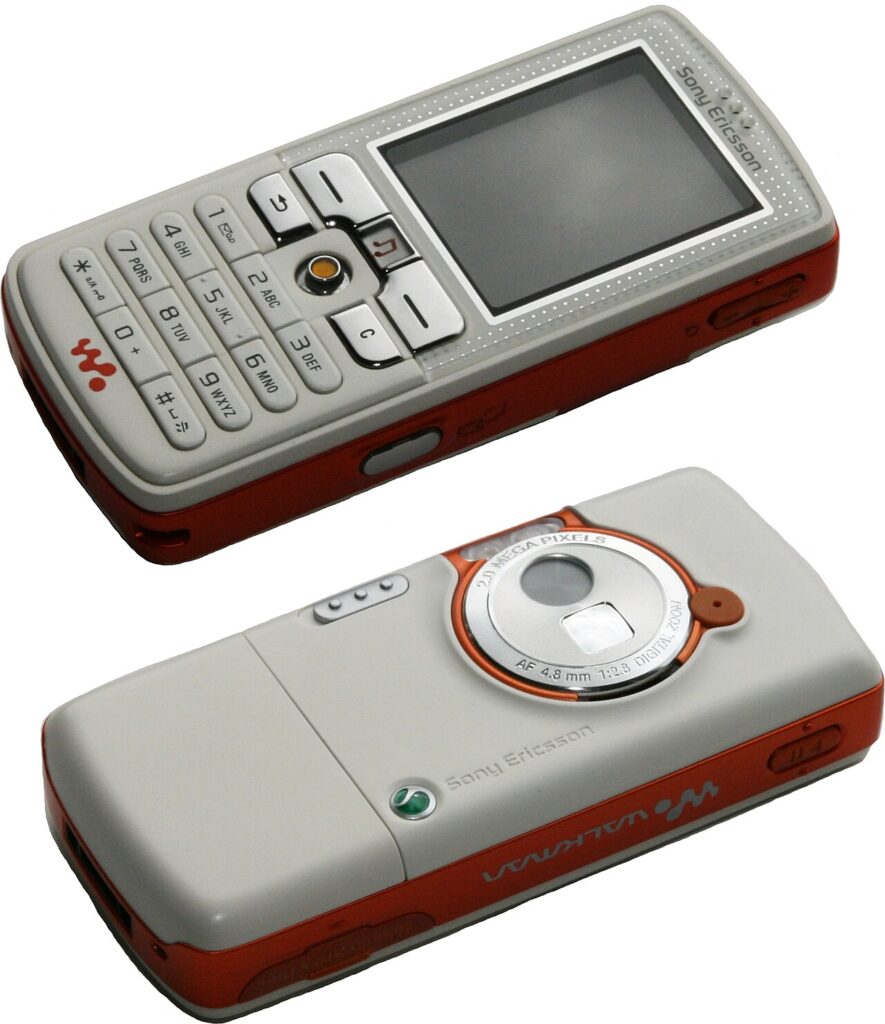
3. Walkman W series (2005 onwards)
The W800, released in August 2005, was the first Sony Ericsson phone to carry the Walkman brand. It had a 2 megapixel autofocus camera, came with a 512 MB Memory Stick PRO Duo, and could play up to 30 hours of music.
Its HPM-70 stereo headset used a 3.5 mm jack, so users could plug in their own headphones, a big deal at the time. Models such as the W810, W550 and W350 followed. For many buyers, a Walkman phone meant they no longer had to carry a separate music player.
4. Cyber-shot K series (2005 onwards)
The K750, introduced in mid 2005, had a 2 megapixel autofocus camera with an LED flash, which was strong for a phone then. It shared almost all of its hardware with the W800.
Its successor, the K800i, arrived in 2006 with a 3.2 megapixel camera, a xenon flash and 3G. It was among the first phones to carry Sony’s Cyber-shot branding. The K850i followed in October 2007 with a 5 megapixel camera, xenon flash and a burst mode that took nine shots in a row.
5. Sony Ericsson T610 (2003)
Announced in March 2003, the T610 was all about looks. Swedish designer Erik Ahlgren gave it a slim body split by metal halves, inspired by mid-century Scandinavian style. It came in Aluminium Haze, Abyss Blue and Volcanic Red.
It had a 128 by 160 pixel colour screen, Bluetooth, infrared, a small built-in camera and Java games. The T610 won Best Mobile Handset at the 3GSM World Congress in 2004.
Sony Ericsson in India
India mattered to the brand. In 2009, Sony Ericsson called India a priority market and said some of its phones would be made in the country by outsourcing partners. The same year, as part of global cost cuts, it shut its unit in Chennai.
What happened to Sony Ericsson?
The arrival of the iPhone and Android phones changed the market quickly. Sony announced in October 2011 that it would buy Ericsson’s share of the venture for 1.05 billion euros, and the deal closed on 16 February 2012. The company became Sony Mobile Communications and moved its headquarters to Tokyo.
Sony Mobile was later absorbed into Sony Corporation, completed in 2021. After the joint venture ended, Xperia became the name for Sony’s smartphones. The Walkman and Cyber-shot phones that once rivalled Nokia are now collector’s items and nostalgia for a generation of Indian users.
For more nostalgia and lists, browse our listicles and reviews section.
Frequently asked questions
Which was the first Sony Ericsson phone?
The first Sony Ericsson branded handset was the C1002S, released in Japan in December 2001. The T68i, a relaunched Ericsson T68, followed in 2002.
Which was the first Sony Ericsson Walkman phone?
The W800, released in August 2005, was the first Sony Ericsson phone to use the Walkman brand.
Which Sony Ericsson phone had the best camera?
Among these, the K850i had the highest resolution, about 5 megapixels with a xenon flash. The K800i had a 3.2 megapixel camera.
When did Sony Ericsson end?
Sony completed its buyout of Ericsson’s stake on 16 February 2012, and the company became Sony Mobile Communications.
Sources: Sony Ericsson (Wikipedia), Sony Ericsson W800 (Wikipedia), Sony Ericsson K850i (Wikipedia), Sony Ericsson T610 (Wikipedia).