


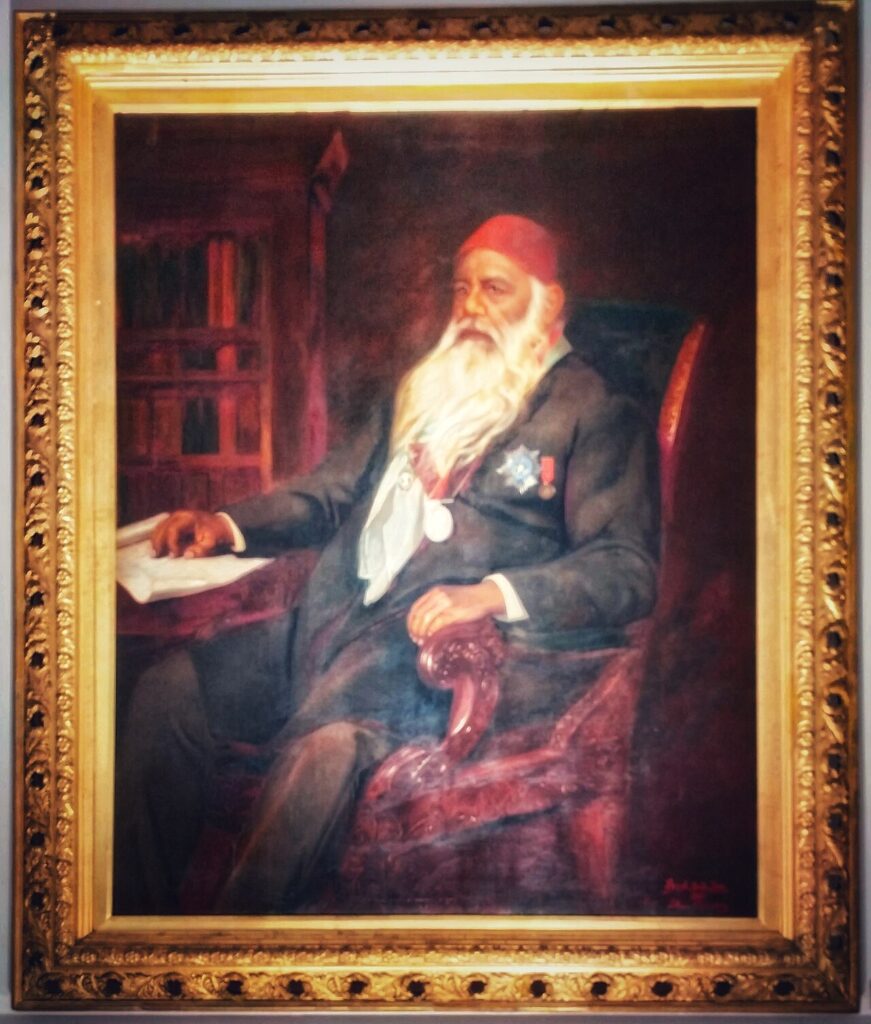
The best-known Sir Syed quotes are about education, reason and Hindu-Muslim unity, such as “Be-ilmi muflisi ki maan hai” (ignorance is the mother of poverty) and his line calling Hindus and Muslims the two eyes of India. Sir Syed Ahmad Khan (1817 to 1898) founded the college that became Aligarh Muslim University.
Every year on 17 October, Aligarh Muslim University and its alumni around the world mark Sir Syed Day, his birth anniversary. 2026 marks 209 years since his birth. This refreshed list puts his most quoted lines in one place, in Roman Urdu with simple English meanings, along with the context you need to read them correctly.
Sir Syed Ahmad Khan: quick facts
| Detail | Fact |
|---|---|
| Born | 17 October 1817, Delhi |
| Died | 27 March 1898, Aligarh |
| Scientific Society of Aligarh | Moved to Aligarh and renamed in 1864 |
| Tahzeeb-ul-Akhlaq journal | First issue 24 December 1870 |
| MAO school, Aligarh | Opened 24 May 1875, became a college in 1877 |
| Aligarh Muslim University | College became AMU in 1920 |
| Honours | Knighthood (KCSI) in 1888, honorary LLD from Edinburgh in 1889 |
Who was Sir Syed?
Sir Syed was a judicial officer in British India, a scholar and a social reformer. After 1857, he argued that Indian Muslims had fallen behind because they had turned away from modern education, and that the answer was science, English and open debate, not nostalgia.
His books include Asar-us-Sanadid (1847), a record of Delhi’s monuments, and Asbab-e-Baghawat-e-Hind, his analysis of the causes of the 1857 revolt. His journal Tahzeeb-ul-Akhlaq pushed Urdu towards simple, direct prose, which is why many writers call him a father of modern Urdu prose.
Best Sir Syed quotes, with meaning
The Roman Urdu lines below are from the collection of his sayings published by Rekhta. Some are shortened to the main sentence.
1. “Be-ilmi muflisi ki maan hai.”
Meaning: Ignorance is the mother of poverty. He goes on to say that a community that loses knowledge and skill is soon followed by poverty. This is the line most quoted on Sir Syed Day, and it sums up why he spent his life building schools.
2. “India is a beautiful bride and Hindus and Muslims are her two eyes.”
Meaning: Both communities are equally precious to India. He added that if one eye is hurt, the bride loses her beauty. It is his most famous line on Hindu-Muslim unity.
3. “Hum log aapas mein kisi ko hindu, kisi ko musalmaan kahein, magar ghair-mulk mein hum sab native yaani hindustaani hain.”
Meaning: Among ourselves we may call one person Hindu and another Muslim, but in a foreign land we are all natives, that is, Indians. A simple point about shared identity that still lands today.
4. “Sabse bada aib hum mein khud-gharzi ka hai.”
Meaning: Our biggest flaw is selfishness. He called it the main reason for a community’s decline and lack of refinement. Sir Syed was always more critical of his own people than of outsiders.
5. “Jo baatein hamaare mukhaalif hamaari nisbat mansoob karte hain, hum usse ziyaada ilzaam ke laayaq hain.”
Meaning: We deserve even more blame than what our opponents accuse us of. A rare example of a leader asking his own community to look in the mirror first.
6. “Raayon ke band rahne se tamaam insaanon ki haq-talfi hoti hai.”
Meaning: When opinions are shut down, every human being is denied their rights. This is Sir Syed the rationalist, arguing for free discussion over blind acceptance.
7. “Jisko izzat hai usko ghairat hai, jisko ghairat hai usko izzat hai.”
Meaning: Those who have honour have self-respect, and those who have self-respect earn honour. He linked dignity to how people carry themselves, not to birth or title.
8. “Lahja: isko bhi tahzeeb mein bada daakhal hai.”
Meaning: Tone of voice is a big part of good manners. In his writing on tahzeeb (civility), he warned against a rough, harsh way of speaking.
9. “Main apni zabaan se wo muraad leta hun jo har shakhs usko samajhta ho.”
Meaning: By language, I mean words that everyone can understand. This explains his plain style of Urdu writing, which broke away from heavy, ornamental prose.
10. “Philosophy will be in our right hand, natural science in our left, and the crown of faith on our head.”
Meaning: Modern knowledge and faith can go together. This line is widely quoted by AMU and historians to describe his vision for the Aligarh college, though wording varies between translations.
What these quotes tell us about Sir Syed
Read together, the quotes show three steady ideas. First, education is the way out of poverty. Second, reason and open debate matter more than tradition for its own sake. Third, India’s communities share one home and one fate.
His views were not without critics, then and now, especially his opposition to the Indian National Congress. But on education, his legacy is clear: an institution in Aligarh that has trained generations of students across India. For more quote collections and lists, see our listicles section, and for profiles of well-known Indians, our celebs section.
Frequently asked questions
What is the most famous quote of Sir Syed Ahmad Khan?
“Be-ilmi muflisi ki maan hai” (ignorance is the mother of poverty) and his line that Hindus and Muslims are the two eyes of India are the most quoted.
When is Sir Syed Day celebrated?
Sir Syed Day is celebrated on 17 October, his birth anniversary, by Aligarh Muslim University and its alumni associations worldwide.
What did Sir Syed say about Hindu-Muslim unity?
He described India as a beautiful bride with Hindus and Muslims as her two eyes, and said that harm to either would spoil her beauty.
Which university did Sir Syed found?
He founded the Muhammadan Anglo-Oriental school in Aligarh in 1875. It became a college in 1877 and Aligarh Muslim University in 1920.
Sources: Syed Ahmad Khan on Wikipedia, Sir Syed’s sayings on Rekhta, Aligarh Muslim University.