

The most interesting facts about Uranus are that it spins on its side, it is the coldest planet in the solar system, one year there lasts 84 Earth years, and it has 29 known moons named after characters from Shakespeare and Alexander Pope. It is also the only planet visited by just one spacecraft, Voyager 2, in 1986.
Uranus is the seventh planet from the Sun and one of the least explored. It sits about 20 times farther from the Sun than Earth does, roughly 3 billion km away.
Our older version of this article had two errors: Uranus is not the planet closest to the Sun, and it does not travel backward in time. Here are the correct, updated facts.
Uranus quick facts
| Detail | Value |
|---|---|
| Position | 7th planet from the Sun |
| Average distance from Sun | About 20 AU (around 3 billion km) |
| Diameter | About 50,700 km, roughly 4 times Earth |
| Mass | About 14.5 Earth masses |
| Length of day | About 17 hours 14 minutes |
| Length of year | About 84 Earth years |
| Axial tilt | About 98 degrees |
| Known moons | 29 |
| Known rings | 13 |
10 amazing facts about Uranus
1. It is an ice giant, not a gas giant
Uranus and Neptune are called ice giants. Under a thick atmosphere of hydrogen and helium, most of Uranus is made of water, ammonia and methane in hot, dense fluid form, around a small rocky core.
It is the third largest planet by diameter but only the fourth by mass, because Neptune is smaller but heavier.
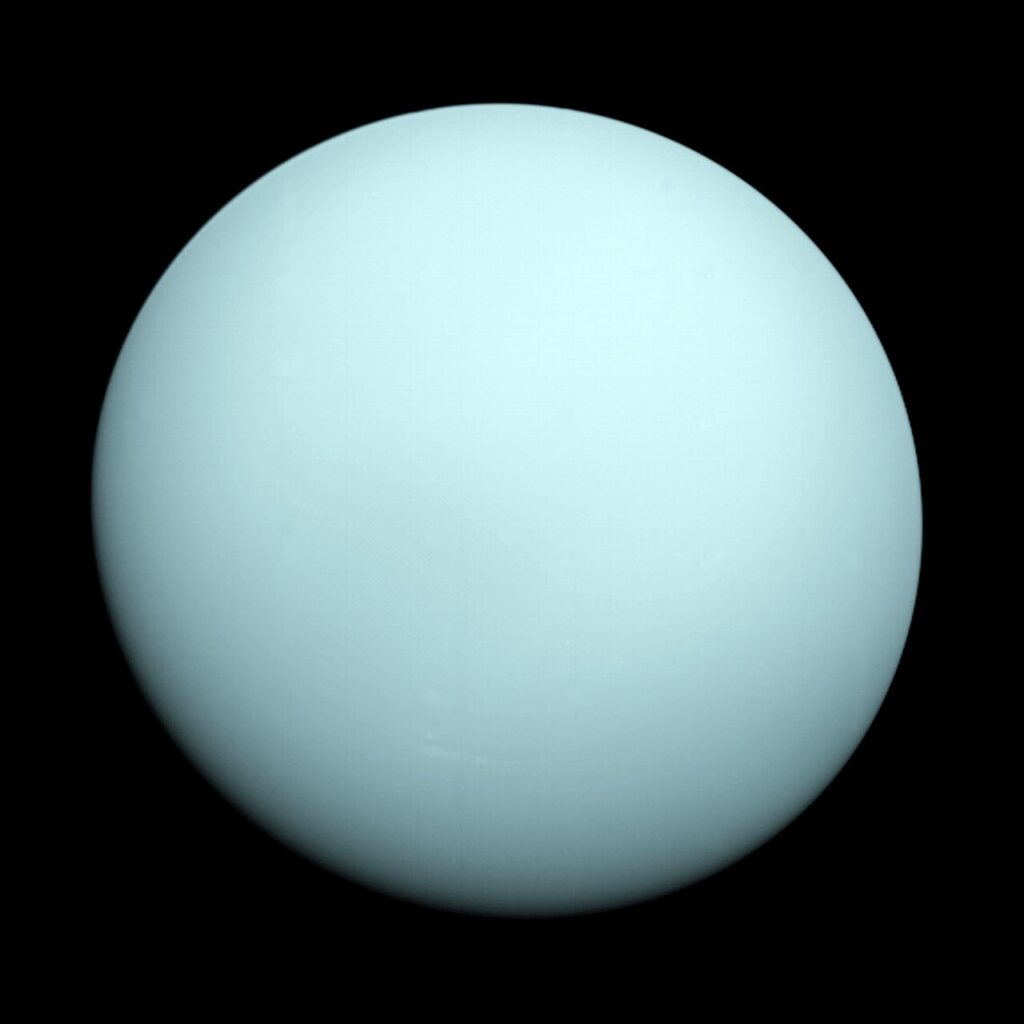
2. Its blue-green colour comes from methane
The atmosphere is about 83 percent hydrogen, 15 percent helium and around 2 percent methane. Methane absorbs red light and reflects blue and green, which gives Uranus its pale cyan look.
3. It was the first planet found with a telescope
William Herschel spotted Uranus on 13 March 1781 from his garden in Bath, England. At first he reported it as a comet. Only later did astronomers confirm it was a new planet.
Herschel wanted to name it after King George III. The name Uranus, after the Greek god of the sky, was chosen instead. It is the only planet named after a Greek god rather than a Roman one.
4. It rolls around the Sun on its side
Uranus has an axial tilt of about 98 degrees, so its poles point almost straight at the Sun at some points in its orbit. Scientists think a giant collision long ago may have knocked it over.
Because of this tilt, each pole gets about 42 years of continuous sunlight followed by about 42 years of darkness.
5. It spins the opposite way to most planets
Like Venus, Uranus has retrograde rotation, meaning it spins in the opposite direction to most planets. A day on Uranus lasts about 17 hours and 14 minutes.
6. It is the coldest planet in the solar system
Neptune is farther from the Sun, yet Uranus holds the record for the lowest temperature measured on any planet: about 49 kelvin, or minus 224 degrees Celsius. Uranus gives off very little internal heat, which is one reason it is so cold.
7. One year lasts 84 Earth years
Uranus takes about 84 Earth years to go around the Sun once. Since Herschel found it in 1781, it has completed fewer than three full orbits.
8. It has 29 moons, and one was found in 2025
Uranus has 29 known moons. The five largest are Titania, Oberon, Umbriel, Ariel and Miranda. Most are named after characters from William Shakespeare’s plays and Alexander Pope’s poem The Rape of the Lock.
In August 2025, a team using NASA’s James Webb Space Telescope announced a new moon, S/2025 U1. It is only about 8 to 10 km across, too small and faint for Voyager 2 or Hubble to have seen.
9. It has 13 thin, dark rings
Uranus has 13 known rings. They are narrow and dark, unlike Saturn’s bright, wide rings, and were first detected in 1977. Some scientists think they are fairly young and may have formed from broken moons.
10. Only one spacecraft has ever visited
NASA’s Voyager 2 flew past Uranus in January 1986, and no spacecraft has returned since. A 2024 reanalysis of its data suggested Voyager 2 may have arrived during unusual solar wind conditions, which could explain some of the strange readings it took.
A Uranus Orbiter and Probe was named the top priority for NASA’s next flagship mission in the 2023 to 2032 planetary science decadal survey. China has also proposed a Uranus flyby. No mission has launched yet.
More strange details about Uranus
Its winds can reach about 900 km/h. Surface gravity, measured at the cloud tops, is about 89 percent of Earth’s, so you would weigh a little less there if you could stand on it, which you cannot.
On very dark, clear nights Uranus is just about visible to the naked eye as a faint dot. For more fun fact lists, see our listicles. Space also shows up a lot on screen, so check our movies section for sci-fi picks.
Frequently asked questions
Why is Uranus tilted on its side?
Scientists think one or more huge collisions early in the solar system’s history knocked Uranus over. Its tilt is about 98 degrees.
How many moons does Uranus have?
Uranus has 29 known moons as of 2026. The newest, S/2025 U1, was announced in August 2025 using the James Webb Space Telescope.
Is Uranus the coldest planet?
Yes. Uranus has recorded the lowest temperature of any planet, about minus 224 degrees Celsius, even though Neptune is farther from the Sun.
Who discovered Uranus?
William Herschel discovered Uranus on 13 March 1781. He first thought it was a comet.
Sources: Wikipedia: Uranus, Wikipedia: Moons of Uranus, NASA: Uranus.